Frequently Asked Questions

Fire Risk Assessments

How often should a fire risk assessment be reviewed?

A fire risk assessment should be reviewed regularly, typically every 12 months or whenever significant changes occur in the building, workforce, or processes.

What happens if I don’t have a fire risk assessment?

Failure to have a suitable and sufficient fire risk assessment can result in fines, legal action, or even imprisonment if serious breaches are identified.

Do I need a written fire risk assessment?

If your business has five or more employees, it is a legal requirement to keep a written record of the significant findings of your fire risk assessment.

Can I carry out the fire risk assessment myself?

While it's possible to do it yourself, it’s highly recommended to use a qualified professional to ensure all risks are properly identified and addressed, especially for larger or more complex premises.

Fire Risk Assessment Surveys

Is a fire risk assessment required by law in the UK?

 Yes. The Regulatory Reform (Fire Safety) Order 2005 makes it a legal requirement for all non-domestic premises and communal areas of residential buildings.

How often should a fire risk assessment be reviewed?

There is no fixed interval, but the assessment must be reviewed regularly and whenever there are significant changes to the building, occupancy, layout, or processes. An annual review is widely considered best practice.

Can I carry out a fire risk assessment myself?

If you possess the necessary training, knowledge, and experience, you may proceed. However, many businesses choose to appoint a competent third-party assessor to ensure thoroughness and compliance.

What happens if I don’t have a fire risk assessment?

You risk enforcement action from the fire and rescue authority, which may include improvement notices, prohibition of building use, fines, or prosecution.

Do I need to document my fire risk assessment?

Yes, if you employ five or more people, or if a license or regulatory authority requires it. The written record must include significant findings and the actions taken to mitigate risk.

Is third-party accreditation important?

Yes. Choosing an appropriately qualified and registered fire risk assessor gives you confidence that your assessment meets recognised competency standards and offers legal reassurance.

Fire Extinguishers

How Often Should Fire Extinguishers Be Checked?

Fire extinguishers must undergo a basic service annually, as British Standard BS 5306-3 stipulated. This includes a thorough inspection and maintenance check by a qualified technician. Additionally, the responsible person at the premises should conduct visual inspections at least once a month. Extended services are required every 5 years for water-based, powder, and clean agent extinguishers and every 10 years for CO2 extinguishers.

How to Use a Fire Extinguisher?

While specific instructions may vary by extinguisher type, the general procedure is as follows:

PULL the pin to break the tamper seal.
AIM low, pointing the nozzle at the base of the fire.
SQUEEZE the handle to release the extinguishing agent.
SWEEP from side to side at the base of the fire until it’s extinguished.

What Fire Extinguisher to Use on Electrical Fires?

Use non-conductive extinguishing media such as carbon dioxide (CO2), powder, or other clean agents for electrical fires. These are specifically designed for electrical equipment fires.

How Many Fire Extinguishers Are Required for Business Premises?

The requirement depends on the premises’ size and specific risks identified in the fire risk assessment. BS 5306-8 states that each floor or level up to 400m2 needs at least two water-based (Class A) extinguishers with a combined minimum total fire rating of 26A. Additional extinguishers for other classes of risks, such as electrical equipment and flammable liquids, must be provided as identified by the fire risk assessment.

What are the Four Types of Fire Extinguishers?

There are more than four types, but the four most common types of fire extinguishers in the UK are:
Water Extinguishers: Suitable for Class A fires involving combustible materials like wood, paper, and textiles.
Foam Extinguishers: Effective on Class A and B fires involving flammable liquids.
Dry Powder Extinguishers: Versatile, used on Class A, B, and C fires (flammable gases) and electrical fires.
CO2 Extinguishers: Ideal for electrical and flammable liquid fires (Class B).

Fire Alarm Maintenance

What type of Fire Alarm Systems do I need?

  1. There are an extensive range of Fire Alarm Systems on the market from different manufacturers all providing their own individual unique methods of detecting a fire. The design of the Fire Alarm System after establishing what category the fire alarm should be needs to be undertaken by a qualified and competent person (designer). The level of protection needs also to be agreed with the owner/occupier of the building. This discussion also identifies and justifies and variations to the design and these need to be clearly documented for the benefit of all parties. The design must detail the detection and alarm zones as well as:
    • Where the manual call points should be sited
    • The location of point smoke and heat detectors in accordance with BS5839 design guidelines
    • Siting of beam detectors (if required)
    • Agreement of any other forms of detection within the building
    • Specification relating to the cable of each circuit
    • Specification to confirm the systems type and equipment i.e. addressable and non-addressable fire alarm systems

What is the difference between an Addressable and Non-Addressable fire alarm system?

  1. What is the difference between an Addressable and Non-Addressable fire alarm system?

    Simply speaking there are two different types of fire alarm system: Addressable and Non-Addressable. Their differences are as follows:

    Addressable

    A more comprehensive fire alarm system than a non-addressable fire alarm. The fire alarm panel allows you to ‘address’ it. It will tell you on the display whether the system has a fault, and where that fault may be. It will also on activation of the system allow the user to identify which call point or point detector has been activated in the building and its location. Addressable fire alarm systems are most suitable in large buildings or building of more complex design as it allows the building occupier to quickly identify the location of the activation without having to walk the whole building. This type of system will give the user more flexibility as it can be programmed to link with other systems in the building such as BMS shutdowns. It can also be linked to a monitoring station so any activation out of normal working hours can be quickly communicated to the emergency services or the building occupier.

    Non-Addressable

    As the name states the system cannot be ‘addressed’ i.e. there is no LCD display on the panel that identifies the location of the call point or detector activation. Therefore, the building user is relying on the zonal chart which in accordance with BS5839 guidelines should be mounted next to the fire alarm panel. This type of system is more often installed in smaller premises such as shops, small retail units or buildings of simple layout and design.

What are the different types of Fire Detection?

  1. Point Detection

    The key to reliable, robust fire systems is having the right detector in the correct place. If the system is too sensitive it will generate unwanted alarms and won’t be regarded as giving accurate information, not sensitive enough and it won’t protect the building. Smoke and heat detectors can only detect fires once a certain amount of smoke or heat has reached the sensor. Therefore, it is important that the detector is correctly installed on a flat ceiling with no obstructions. The radius of detection for a smoke sensor is 7.5m and 5.3m for a heat detector. Detectors should be mounted a minimum of 0.5m from a wall. All smoke detectors that we supply conform to EN 54 – 7 and installed in accordance with BS5839 guidelines. We also install detectors in voids less than 800mm deep, unless on the basis of the Fire Risk Assessment it is thought that fire or smoke could spread extensively though the voids before detection, or unless the fire in the void is such to warrant protection.

    Laser Point Detection

    If a particle of smoke (or dust) enters the chamber, light from the laser is scattered and the detector, using its patented algorithms, checks the nature of the scattered light to determine whether the source is dust or smoke. If a determination of smoke is made, the alarm is signalled.

    Beam Detection

    Beam detection offers unique capabilities and limitations over point detection. They are particularly beneficial in wide open warehouses with big expansion of space. There are two basic types end to end detection which operate on the obscuration of light and end to end detection which has a separate transmitter and receiver unit. Once the beam is broken by rising particles of smoke and fumes the system will go into alarm.

    Wireless Detection

    Wireless smoke alarm systems interconnect without the need to be hardwired and help to detect the presence of smoke, heat and carbon dioxide. Early detection of a fire can help to prevent loss of life and minimise damage to domestic and commercial buildings. Wireless smoke alarms are relatively easy to reposition if required. Most require a radio survey in order to measure signal strength between points before installation to ensure they will operate correctly. They are particularly suitable for historical buildings as no cabling is required or retrospective fitting in more challenging building complexes. They can however be more expensive to install then a conventional system and as they operate on batteries often require more ongoing maintenance than a hard-wired system.

    Open Area Smoke Detection

    As an alternative to traditional beam detection open area smoke imaging detection (OSID) is a viable option. Key advantages to the OSID range of detection is that they are less sensitive to unwanted alarms caused by:
    • Building vibration and movement
    • Periodic physical barriers i.e cherry pickers, high level ladders and forklift trucks
    • Insects and birds
    • Dirt, dust and steam
    • Reflective and direct sunlight

    Air Sampling (Aspirating Smoke Detection)

    Aspirating Smoke Detection systems draw air samples continuously from a monitored area through a pipework system with pre-engineered holes drilled at predetermined locations along the pipe work run. The air is then sampled and analysed for smoke particles and the alarm will activate if smoke is detected as present. Some aspirating systems can now be remotely monitored through IP connectivity, maximising the benefits of this very early warning capability in reacting to a fire incident.

    Flame Detection

    A flame detector is a type of sensor that can detect and respond to the presence of a flame. Responses to a detected flame depend on the installation, but can include sounding an alarm, deactivating a fuel line, and activating a fire suppression system. It is quite often used in specialised commercial manufacturing processes as an effective method of fire detection.

    Public Address and Voice Alarms

    Before deciding on a Voice Activation alarm system the evacuation requirements of the building must be established:
    • Is the building to be evacuated all at once (one out all out)?
    • Does the building require a phased evacuation plan?
    This assessment will need to form part of the overall fire strategy and emergency action plan of the building such as complex office blocks, sports stadiums, areas where large numbers of people may assemble. Our design team can help in this process for you.

    Emergency Voice Communication System (EVCS)

    An EVC System is a fixed, monitored and maintained, bidirectional, full duplex voice communication system to help assist the orderly evacuation of disabled or mobility impaired people and assist the fire service in terms of communication during an emergency.

How often should my Fire Alarm System be tested?

  1. Your fire alarm should be tested on a weekly basis. This is usually conducted by the responsible person on site or a nominated Fire Marshal. Each fire alarm call point should be tested on a weekly basis on rotation and a record of the test should be entered into the company’s fire logbook. This is a requirement of being compliant in accordance with The Regulatory Reform (Fire Safety) Order 2005 and BS5839 guidelines.

Commercial Fire Alarm Installation & Maintenance Nottingham, Derby & Leicester
  1. Our engineers can number your fire alarm call points so that when you conduct your weekly test you can enter the appropriate call point number against your records to demonstrate to any inspecting authority you have tested 100% of your building call points over a period of time.

    The weekly testing procedure ensures that fire alarm signals operate correctly (if you are on a monitored system) and appropriate signals are clearly received by the monitoring station.

    Most of our customers carry out the weekly test of their fire alarm at the same time to ensure there is no confusion for building users as to whether it is a test or genuine fire alarm activation. This should also form part of your company’s fire emergency strategy/emergency plan.

    Our engineers can help demonstrate how to do this if you are unsure or new to the role of weekly testing. Furthermore, they carry a wide stock of fire alarm test keys for the different systems out in the market to ensure you remain compliant with your weekly testing schedule.

How often should my Fire Alarm System be serviced?

  1. In accordance with The Regulatory Reform (Fire Safety) Order 2005 and BS5839 guidelines (Fire Alarm Systems) fire alarm should be serviced on an annual basis. It recommends that two inspections take place per annum by a competent and qualified person at a maximum of no more than 6 months apart.

    At Firecom Systems Ltd all our engineers are BAFE trained and qualified to the highest industry standards. Therefore, when we award you with your inspection certification you can be reassured that your fire alarm system has not only been serviced correctly in accordance with BS5839 guidelines, but also by an experienced, professional, and qualified engineer.

    At each inspection our engineer tests the fire alarm panel for functionality, battery loadings and calculations and 50% of the building detection system by using a smoke and heat pole (for heat detectors), to ensure the detection system is operating correctly and in accordance with industry guidelines.

    On completion of the onsite testing our engineer will issue a certificate demonstrating your compliance with the standards and recording the performance of your fire alarm system. He will also make a record of any requirements or remedial works such as failed or slow to react detectors. It is recommended that smoke detectors are replaced around every ten years and again our team can discuss a rolling programme of upgrade works to ensure sensible budgeting costs of your life safety systems.

Fire Alarm Testing & Inspection

How often should fire alarm systems be tested?

Fire alarm systems should undergo weekly testing, typically by the responsible person or a designated fire marshal. Each manual call point should be tested in rotation, and records of these tests should be maintained in the company’s fire logbook.

What does a fire alarm maintenance schedule involve?

Maintenance should include bi-annual inspections by qualified personnel, during which the functionality of the fire alarm panel, detectors, and other components are thoroughly tested to ensure compliance with BS5839 guidelines.

What are the different categories of fire alarm systems?

Fire alarm systems are categorised based on their design and purpose:

  • Category M: Manual systems with call points and sounders, relying on occupants to activate the alarm.
  • Category L: Automatic systems intended for the protection of life, subdivided into:
  • L1: Comprehensive coverage throughout the building.
  • L2: Detection in escape routes and specified high-risk areas.
  • L3: Detection in escape routes and rooms opening onto these routes.
  • L4: Detection in escape routes only.
  • L5: Systems designed for specific fire safety objectives.
  • Category P: Automatic systems intended for the protection of property, subdivided into:
  • P1: Detection throughout the building.
  • P2: Detection in defined parts of the building where the risk of ignition is high or where the contents are particularly valuable.

Why is third-party certification important for fire safety service providers?

Third-party certification, such as that provided by BAFE (British Approvals for Fire Equipment), offers assurance that a service provider meets recognised standards of quality and competence. Government guidance often recommends this certification, which can be crucial in demonstrating compliance with legal obligations.

What should be included in a fire alarm logbook?

A fire alarm logbook should document all system tests, maintenance activities, and any incidents or false alarms. This record is essential for demonstrating compliance with fire safety regulations and identifying recurring issues needing attention.

Partnering with Firecom Systems Ltd ensures that your fire alarm systems are tested, maintained, and compliant with all relevant regulations, providing peace of mind and safeguarding your business against potential fire hazards.

What is BS 5839?

BS 5839 is a comprehensive British Standard that provides guidelines for designing, installing, commissioning, and maintenance of fire detection and fire alarm systems in non-domestic premises. It is divided into several parts, with Part 1 specifically addressing systems in non-residential buildings. The standard ensures that fire alarm systems are reliable and effective, facilitating early detection and warning of fires to protect life and property.

What is the Regulatory Reform (Fire Safety) Order 2005?

The Regulatory Reform (Fire Safety) Order 2005 (often abbreviated as RRO or FSO) is a statutory instrument that came into force in England and Wales on 1 October 2006. It consolidated and simplified previous fire safety legislation, placing the responsibility for fire safety firmly on the “responsible person” within a premises. This individual is typically the employer, owner, or person in control of the premises. The Order requires that the responsible person:

  1. Conduct regular fire risk assessments.
  2. Implement appropriate fire safety measures to mitigate identified risks.
  3. Maintain fire safety precautions and facilities.
  4. Ensure that occupants are informed about fire safety procedures.
  5. Provide adequate fire safety training to staff.

The RRO applies to virtually all non-domestic premises, including workplaces, commercial establishments, and the communal areas of residential buildings. Failure to comply with the Order can result in enforcement actions, including fines and imprisonment.

What are the key articles of the Regulatory Reform (Fire Safety) Order 2005?

The Order comprises several articles outlining specific duties and requirements. Key articles include:
  • Article 3: Defines the “responsible person” for fire safety within a premises.
  • Article 8: Mandates the duty to take general fire precautions to ensure the safety of employees and relevant persons.
  • Article 9: Requires the responsible person to conduct a suitable and sufficient fire risk assessment.
  • Article 11: Obligates the responsible person to implement preventive and protective fire safety measures.
  • Article 13: Ensures appropriate fire detection and alarm systems are in place.
  • Article 14: Requires the maintenance of safe and accessible emergency routes and exits.
  • Article 15: Mandates establishing procedures for serious and imminent danger, including fire emergencies.
  • Article 17: Requires the maintenance of fire safety measures to ensure they remain effective.
  • Article 21: Ensures that employees receive adequate fire safety training.
To fully understand all duties and requirements, it is advisable to consult the full text of the Order or seek guidance from fire safety professionals.

How do BS 5839 and the Regulatory Reform (Fire Safety) Order 2005 relate to each other?

BS 5839 provides detailed guidance on the technical aspects of fire detection and alarm systems, ensuring they are designed, installed, and maintained to a high standard. The Regulatory Reform (Fire Safety) Order 2005, on the other hand, establishes the legal framework for fire safety responsibilities within premises. Compliance with BS 5839 can assist the responsible person in meeting their obligations under the RRO, particularly concerning providing and maintaining adequate fire detection and alarm systems.

Who enforces the Regulatory Reform (Fire Safety) Order 2005, and what are the penalties for non-compliance?

The enforcement of the RRO is primarily the responsibility of local fire and rescue authorities. They conduct inspections and can issue enforcement notices requiring improvements in fire safety measures. Failure to comply with the Order can result in severe penalties, including fines and imprisonment. Specifically, the responsible person can face imprisonment for up to two years and/or fines of up to £10,000 for each breach of the Order’s articles. Companies can face unlimited fines for corporate fire safety failings. Additionally, legal costs incurred during prosecution may also be recovered from the convicted party.

Understanding and adhering to both BS 5839 and the Regulatory Reform (Fire Safety) Order 2005 are crucial steps in ensuring the safety of occupants and the protection of property from fire-related risks.

Fire Sprinkler Systems

How often should my fire sprinkler system be inspected?

BS EN 12845 and BS 9251:2021 require quarterly flow switch tests and annual full inspections. Depending on the system type, additional checks may be required.

What are the penalties for non-compliance?

Failure to comply with fire sprinkler regulations can result in fines, legal action, and increased insurance premiums. In severe cases, non-compliant businesses may be shut down.

Do all buildings need fire sprinklers?

Not all buildings require fire sprinkler systems, but high-risk structures, such as high-rise flats and commercial warehouses, must meet strict compliance standards.

What documentation is required for fire sprinkler compliance?

Businesses must maintain inspection records, compliance certificates, and servicing logs to prove that their fire sprinkler systems are up to standard.

How do I schedule a fire sprinkler system inspection?

Contact Firecom Systems for a professional fire sprinkler system inspection and compliance check. We provide tailored services to ensure your system meets UK regulations.

What are the LPC Rules for Automatic Sprinkler Installations 2015, and how do they relate to compliance?

The LPC Rules for Automatic Sprinkler Installations 2015 incorporate BS EN 12845 and provide detailed industry guidance for designing, installing, and maintaining fire sprinkler systems in commercial and industrial settings.

While not legally binding, following these rules ensures full compliance with The Regulatory Reform (Fire Safety) Order 2005 and is recognised as best practice for fire safety compliance.

How often should I check my fire sprinkler system?

Regular fire sprinkler system inspections are essential for compliance and performance. A general inspection schedule includes the following:

  • Weekly: Visual checks of control valves, water pressure, and sprinkler heads.
  • Monthly: Testing of water pumps and verifying system pressure levels.
  • Quarterly: Professional inspections, including alarm testing and valve checks.
  • Annually: Full system inspection by a qualified professional, including hydraulic performance tests.

Keeping to this schedule ensures compliance with BS EN 12845 and LPC Rules for Automatic Sprinkler Installations 2015.

Why is it important to log fire sprinkler system inspections?

Fire sprinkler inspections must be documented to provide proof of compliance with UK fire safety regulations. A proper inspection log should include:

  • The date of inspection.
  • Details of the checks performed.
  • Any issues identified.
  • Corrective actions taken or required.

Keeping accurate records ensures responsible persons can demonstrate fire safety compliance and provide a system performance history.

How do fire sprinklers integrate with fire alarms, and do they need to be tested together?

Fire sprinklers and alarms often work together for early fire detection and suppression. Some fire sprinkler systems include alarm-activated flow switches that must be tested during quarterly inspections to verify the following:

  • Water flow triggers the fire alarm system correctly.
  • The system sends a signal to fire monitoring stations where required.
  • Alarm panels accurately display sprinkler activation.

Ensuring these connections work properly is critical to fire sprinkler system compliance.

What happens after a fire sprinkler system activates?

Once a fire sprinkler system activates, certain components must be reset or replaced to restore full functionality. This includes:

  • Replacing activated sprinkler heads, as they are single-use.
  • Checking and refilling the water supply to ensure it meets the required capacity.
  • Resetting control valves to allow the system to function normally.
  • Inspecting for any pipework damage that may have occurred due to heat exposure.

Following an activation, an immediate fire sprinkler system inspection is required to confirm the system remains compliant and ready for future use.

Fire Hydrants

Do Fire Hydrants Need to be Tested?

Yes, fire hydrants do need to be tested. Regular testing is essential to ensure they function correctly and provide a continuous water supply from the mains during a fire. Testing identifies defects that could affect their performance, such as leaks or malfunctioning valves.

How Often Should You Get a Hydrant Inspection?

Fire hydrants should be inspected and serviced annually to ensure they have the right water pressure and flow rate.

Why do we Need a Fire Hydrant Inspection?

Fire hydrant inspections are crucial for ensuring that hydrants are in proper working order and can provide an adequate water supply during a fire. Regular inspections help to identify and rectify any issues that could hinder their performance, thereby ensuring the safety of the public and property.

Do I Need a Fire Hydrant Service Certificate?

Yes, it is important to have a Fire Hydrant Service Certificate. The certificate demonstrates that the hydrant has been tested and maintained correctly. In the event of an incident, fire investigators may ask to see this certificate to verify compliance with fire safety standards.

What are the UK Fire Hydrant Testing & Maintenance Requirements?

In the UK, fire hydrant testing and maintenance must comply with British Standard BS9990:2015. Hydrants should be tested annually to check for adequate water pressure and flow rate, and any defects or issues should be addressed promptly. This testing is a legal requirement for commercial and private fire hydrants, and failure to comply can result in legal repercussions.

Fire Suppression

What Types of Fire Suppression Systems do you offer?

Firecom Systems Ltd offers a range of fire suppression systems and kitchen fire suppression systems, including CO2 gas fire suppression systems suitable for various applications such as CNC machines, industrial printing presses, server rooms, and vehicle suppression systems.

How do Fire Suppression Systems work?

Fire suppression systems detect fire in the protected area and automatically release suppressant gas to extinguish it. For server rooms, systems like Inergen or FM200 are used, and upon confirmation of fire, the gas is released. The system includes alarms and visual beacons to notify personnel in the area.

What are the Key Benefits of Installing a Fire Suppression System?

The key benefits include enhanced safety by quickly suppressing fires, minimising equipment and property damage, and ensuring safety regulations compliance. These systems are especially beneficial in areas with high fire risk, like server rooms or industrial settings.

Can Fire Suppression Systems be Customised for Specific Environments?

Firecom Systems Ltd can customise fire suppression systems for specific environments and needs. The company has experience installing systems for various applications, each requiring a particular type of suppressant system.

How often do Fire Suppression Systems need Maintenance and Servicing?

How often do Fire Suppression Systems need Maintenance and Servicing?

Fire suppression systems require regular maintenance to ensure they function correctly. The specific frequency may depend on the type of system and its usage. Still, it typically involves checking the weight or level of suppressant gas and ensuring all components are in good working order.

What is the Process for Installing a Fire Suppression System?

The process starts with a site survey to assess the specific needs and risks. Firecom Systems Ltd then recommends the appropriate fire suppression system and manages the installation process, ensuring it meets all safety standards and requirements.

Are Fire Suppression Systems suitable for all Types of Fires?

Fire suppression systems are designed for specific types of fires, and their effectiveness can vary based on the fire class and the environment. For example, CO2 systems are effective for electrical fires and certain industrial applications but may not suit all fire types.

What Should I Do if the Fire Suppression System Activates?

If the system activates, ensure that all personnel evacuate the area immediately and contact emergency services. Do not attempt to re-enter the area until it has been declared safe by the fire service.

How do I Know if my Facility Needs a Fire Suppression System?

Consider factors like high-risk equipment, the type of materials handled, and regulatory requirements for fire safety. Facilities with high fire risk, such as server rooms or industrial settings with potential ignition sources, are strong candidates for fire suppression systems. Firecom Systems Ltd can advise on what fire safety systems are required for your business premises.

Kitchen Suppression

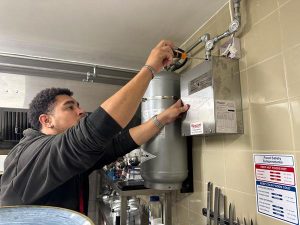
How Does a kitchen Fire Suppression System Work

  1. Each kitchen fire suppression system has a detection line usually installed in the extraction hood and plenum areas. The detection line is held taught under tension. At predetermined points along the line there are soldered fusible links installed which under fire conditions will break at a predetermined temperature and suppress the fire.

Kitchen fire suppression fusible linkKitchen fire suppression suppressant agent cylinder
  1. The tension in the detection line is released and this causes the opening of a valve on the suppressant agent cylinder to allow suppressant liquid to be distributed through the agent pipework. At the end of each pipe run there is a pre-engineered nozzle pointing at an appliance on the cooking range or up into the extraction ducts, plenum and extraction hood.

    The release of the liquid chemical smothers the fire through saponification onto the area of risk through a network of pipework and nozzles shown below.

Commercial Kitchen fire suppression systems

Kitchen Fire Suppression nozzles overhanging a kitchen range

Will the system discharge accidentally without a fire being present?

  1. Put simply – No (unless it hasn’t been correctly installed or maintained). Unfortunately, we tend to find the only systems that tend to discharge on their own are the ones where a regular maintenance programme has not been set up. This also leads to a build up of grease laden vapours on parts such as fusible links meaning that in a fire situation the system will not operate correctly or discharge and suppress the fire.
kitchen-fire-suppression

Which Kitchen Fire Suppression System & which manufacture should I choose?

  1. There are a number of pre-engineered kitchen fire suppression systems on the market.

    The two main systems on the market are Ansul R102 and Amerex manufactured suppression systems. Side by side they also share some common parts such as fusible links and distribution pipework. There is not usually much difference between each system in terms of cost although there are certain advantages and disadvantages to each system depending on the application and design of the kitchen area to be covered.

    Our design team will be happy to provide a quote for either system as well as discuss a full ongoing maintenance package at competitive prices.

    We can offer a Free Site Survey or a free no obligation quotation from your set of drawings.

Kitchen fire suppression systemKitchen fire suppression system comparison

Water Mist Suppression Systems (Kitchens)

  1. At Firecom Systems Ltd we offer a unique pre-engineered Water Mist Kitchen Suppression Systems. Because the system uses very small micron droplets of water it is a very effective system for putting out kitchen oil fires as the water has excellent properties in cooling the fire.

    The biggest benefit of this system is that it is not only eco friendly as it uses only distilled water but the clean-up time (because it is only water), is a lot quicker enabling the restaurant to return to cooking service in a matter of 20 minutes. This is unlike more traditional systems that require longer clean up times due to the nature of the agent being used to suppress the fire following discharge.

Kitchen fire suppressions water mist system
Commercial kitchen fire suppressions water mist system

Water mist nozzles over the kitchen range

Dry Risers

Where are Dry Risers required?

  1. Dry risers should be installed in buildings where the floor is between 11 & 50 meters above ground level. This is roughly equivalent to buildings of between 3 – 17 stories at an operating pressure of 12 bar. The run of horizontal connecting pipe is a maximum of 18m in length in order to ensure the correct pressure of water is achieved.

What is the difference between a Dry Riser and Wet Riser System?

  1. A Dry Riser: is a system of valves and pipe work which enables the fire service to pump water onto upper floors of a building.
  2. A Wet Riser: a system of valves and pipe work which is kept permanently charged with water, generally utilising pumps and tanks.
Dry riser landing valve
A Dry Riser Landing Valve

Why should I have my Dry Riser System(s) serviced?

  1. All dry (or wet) riser systems should be serviced in accordance with BS9990 guidelines on an annual basis. Inspections generally take place every six months. One inspection will be a ‘wet test’ where the riser is charged with water to a pressure of 12 bar to check its integrity. This proves that should water be required in a fire situation the pipework can successfully deliver this when used by the fire service. Our engineers will first check that each landing valve is closed on each floor before performing this test.

    The water pressure achieved during the test needs to hold for a minimum of 10 minutes at 12 bar to ensure the riser has passed the test. Our engineer following the test will provide the necessary certification to not only demonstrate that the Dry Riser has passed its inspection but will also highlight any remedial works required, such as the installation of padlocks and straps (an anti-tamper device).

    The second inspection conducted by our engineer will be a visual check of the system on each floor to ensure straps and padlocks have not been tampered with, glass on the main incoming inlet valve has not been broken or vandalised to ensure that should the system be required in a fire emergency the system will function correctly.

Dry Riser in Nottingham

Dry Riser before service

Dry riser in Nottingham after maintenance

Dry Riser after service
(Effective and long-lasting Repair Works)

PAT Testing

Does PAT testing fall under PUWER?

  1. In addition to the requirements of PAT, electrical equipment is also subject to the requirements of the Provision and Use of Work Equipment Regulations 1998 (PUWER). Therefore, it is important that employers regularly test their electrical equipment by employing a qualified contractor and in accordance with the regulations. This helps promote a safer workplace.

Why do I need to have this done?

  1. Some stationary electrical equipment and IT appliances being used by employees should be PAT tested every 12 months. Portable and handheld equipment which falls under Class II should be tested every 6 months, and Class I equipment should be tested every 6 months. Some larger fixed items which our engineer will identify, will require a test schedule every 3 years. Generally speaking, our clients request an annual PAT testing schedule.

What does the engineer do?

  1. PAT testing is a recognised procedure for inspecting and testing electrical equipment to determine whether it is safe for continued use or if maintenance is required. Guidance on the procedures for PAT testing is provided by the Code of Practice for In-service Inspection and Testing of Electrical Equipment, published by the Institute of Engineering and Technology (IET). The Engineer will then perform a series of tests, visually and using their PAT testing equipment, so that the appliance can be deemed as either safe to use or unsafe to use.
Pat testing digital multi-meter
  1. Many electrical safety defects can be found by visual examination, but some types of defects can only be found by testing. A PAT test involves a visual inspection to check the appliance casing and flex for wear or damage. Plugs are also checked for damage, correct wiring and ensuring that the correct fuse rating is used.

    The duration of a single PAT test is usually around 2-5 minutes. However, the total timeframe for PAT testing depends on the size of the premises and the number of appliances that need to be tested.

    A qualified and experienced PAT tester can test properly on average 150 items per day in an industrial setting and up to 300 items per day in an office setting. Of course, this is largely dependent on access to rooms and the equipment, so the number of items tested vary from site to site.

Will I be compliant?

  1. Following our engineers testing of your appliances they will not only put a test sticker on each appliance showing whether it has ‘passed’ or ‘failed’ and the date of the test but also produce an asset list of all the appliances tested on site.

    Their report will record any items that are unsafe and that should be removed from the workplace but also any items which may be considered safe to repair. For example, damaged electrical cables that could cause electrocution would be recorded as unsafe for use and should be replaced.

    Your site will be compliant subject to following the necessary recommendations of any such report and we will automatically contact to you in the future as to when the next test dates are due for your portable appliances.

Derby Fire Safety Services

How does Firecom Systems ensure compliance with fire safety regulations in Derbyshire?

  • At Firecom Safety Systems, we strictly adhere to the latest fire safety and security legislation to ensure all our clients in Derbyshire are fully compliant and safe. Our engineers focus on quality work rather than commission-based targets, guaranteeing the highest service standards. This commitment to compliance and excellence assures our clients that their fire safety systems meet all necessary legal requirements.

What fire safety systems are offered by Firecom Systems in Derby and Derbyshire?

  • Firecom Safety Systems provides a comprehensive array of fire safety solutions in Derby and Derbyshire. Our services include the design and installation of fire alarm systems, sprinkler systems, dry risers, and specialised fire suppression systems for various industries. Additionally, we offer kitchen fire suppression systems, hydrant testing, fire risk assessments, fire training, fire door inspections, and PAT testing. Our team is dedicated to delivering top-notch advice and outstanding after-sales support to ensure your premises are well-protected.

What kind of support can Firecom Systems clients expect in Derby?

  • Clients of Firecom Safety Systems in Derby can rely on dedicated 24/7 support and transparent, competitive pricing. Our strong relationships with major companies in Derby, Derbyshire, and the East Midlands are founded on trust and reliability. With our strategically located office and engineering team, we ensure rapid response times for fire alarms, intruder systems, and suppression system callouts. Our clients benefit from prompt and professional support whenever they need it, ensuring their fire safety needs are always met efficiently.

East Midlands Fire Protection Services

What fire safety systems are provided by Firecom Systems in the East Midlands?

  • Firecom Safety Systems delivers many fire protection services in the East Midlands. We specialise in the design and installation of fire alarm systems, sprinkler systems, dry risers, and industry-specific fire suppression systems. Additionally, we offer kitchen fire suppression systems, hydrant testing, fire risk assessments, fire door inspections, fire training, and PAT testing. Our team is dedicated to providing expert advice and outstanding after-sales support, ensuring your premises are secure.

How does Firecom Systems ensure compliance with fire safety regulations in the East Midlands?

  • At Firecom Safety Systems, we adhere strictly to the latest fire safety and security legislation to ensure all our clients in the East Midlands are fully compliant and safe. Our engineers prioritise quality work without the pressure of commission-based targets, guaranteeing superior service standards. This dedication to compliance and excellence reassures our clients that their fire safety systems meet all necessary legal requirements.

What kind of support can Firecom Systems clients expect in the East Midlands?

  • Firecom Safety Systems clients in the East Midlands can rely on dedicated 24/7 support and transparent, competitive pricing. We have cultivated strong relationships with major regional companies based on trust and dependability. Our strategically located office and engineering team ensure rapid response times for fire alarms, intruder systems, and suppression system callouts. Our clients benefit from prompt and professional support, ensuring their fire safety needs are always efficiently addressed.

Leicestershire Fire Protection Services

What fire safety systems are offered by Firecom Systems in Leicester and Leicestershire?

  • Firecom Safety Systems provides various fire protection in Leicester and Leicestershire. Our services include designing and installing fire alarm systems, sprinkler systems, dry risers, and specialised fire suppression systems for various industries. Additionally, we offer kitchen fire suppression systems, hydrant testing, fire risk assessments, fire training, fire door inspections, and PAT testing. Our team is dedicated to delivering top-notch advice and outstanding after-sales support to ensure your premises are well protected.

What kind of support can Firecom Systems clients expect in Leicester?

  • When you choose Firecom Safety Systems in Leicester, you're choosing a partner that's always there for you. Our clients benefit from dedicated 24/7 support and transparent, competitive pricing. We've built strong relationships with major companies in Leicester, Leicestershire, and the East Midlands based on trust and reliability. With our strategically located office and engineering team, we ensure rapid response times for fire alarm, intruder systems, and suppression system callouts. Our commitment to prompt and professional support means you can rely on us to efficiently meet your fire safety needs whenever you need us.

How does Firecom Systems ensure compliance with fire safety regulations in Leicestershire?

  • At Firecom Safety Systems, we take compliance and excellence seriously. We strictly adhere to the latest fire safety and security legislation, ensuring all our clients in Leicestershire are fully compliant and safe. Our engineers are driven by a commitment to quality work, with non-commission-based targets, guaranteeing the highest service standards. This dedication to compliance and excellence gives our clients the peace of mind that their fire safety systems meet all necessary legal requirements and are of the highest quality.

Nottingham Fire Protection Services

What types of fire safety systems do Firecom Systems provide in Nottingham and Nottinghamshire?

  • At Firecom Safety Systems, we offer a comprehensive range of fire protection options tailored to our clients' diverse needs. Our services include designing and installing fire alarm systems, sprinkler systems, dry risers, and industry-specific fire suppression systems. Additionally, we provide kitchen fire suppression systems, hydrant testing, fire risk assessments, fire training, fire door inspections, and PAT testing. Our Wilford-based team ensures top-tier advice and after-sales support, making us a trusted partner for fire safety in the region.

How does Firecom Systems ensure compliance with fire safety and security legislation?

  • At Firecom Safety Systems, we adhere strictly to the latest fire safety and security legislation, leaving no room for compromise. This ensures that all of our clients are fully compliant and safe. Our engineers are dedicated to quality and are not driven by commission-based targets. This unwavering commitment to excellence and adherence to regulations provides peace of mind for our clients, knowing that their premises are protected and compliant with all legal requirements.

What kind of support can clients expect from Firecom Systems?

  • At Firecom Safety Systems, we value our clients and their safety above all. That's why we offer dedicated 24/7 support and transparent, competitive pricing. Our longstanding relationships with major companies in Nottingham, Nottinghamshire, and the East Midlands are built on trust and reliability. We take pride in our rapid response times, thanks to our strategically placed office and engineering team across the region. Our clients can rely on us for prompt and professional support at any time, whether for fire alarms, intruder systems, or suppression systems, because their safety is our priority.
Fire Risk Assessments
Fire Risk Assessment Surveys
Fire Extinguishers
Fire Alarm Maintenance
Fire Alarm Testing & Inspection
Fire Sprinkler Systems
Fire Hydrants
Fire Supression
Kitchen Suppression
Dry Risers
PAT Testing
Locations

What Our Clients Say

  • "I cannot speak highly enough of Firecom Systems. Their engineers go above and beyond every time. They are efficient, helpful and knowledgeable."
    Laura Morley
    Nottingham
  • "The team at Firecom have been absolutely fantastic from start to finish.
    Each member of the team received Fire Training from Stuart, who was very informative, where we learned how to assess and tackle a fire safely."
    Mitch Shephard
    Nottingham
  • "Would highly recommend Firecom Systems. From our first onsite meeting to the engineer carrying out servicing onsite the communication has been brilliant and engineers were knowledgeable."
    Lauren Trevillyan
    Nottingham
  • "Stuart and the team provided fantastic service at extremely short notice. Their in depth experience shone through immediately and the package received was great value for money!"
    Chris Fischer
    Nottingham
  • "Fantastic fire training provided by Firecom also received the certifcation swiftly. Would highly recommend."
    Danielle H
    Nottingham
  • "Thank you! A fantastic job completed by a great team!"
    Ian Fuller
    Harlow Timber Group

Call 0115 822 2000 or email contactus@firecomsystems.co.uk for a no obligation quote

Contact Us Today
Firecom Systems Ltd. logoDBS Check Logo
Website made with ♡ by Lnet Digital