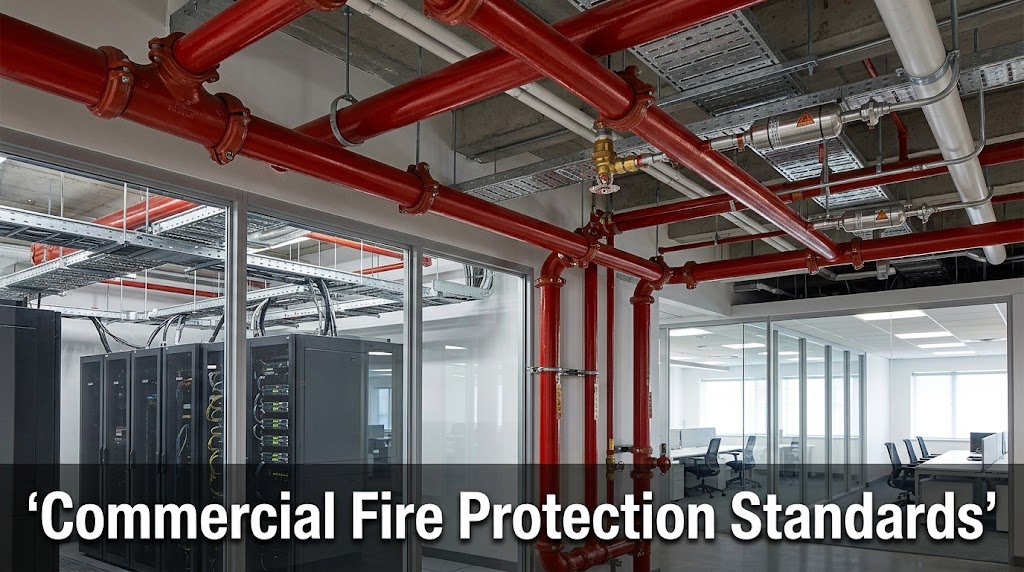
Commercial building owners and facility managers frequently face a critical choice when designing life safety infrastructure, navigating whether water-based protection or specialist clean agents best safeguard their premises. To establish compliant, effective asset protection across industrial sites, offices, and data facilities, professional evaluation of building hazards is essential. This guide examines how protection systems operate under UK legislation, helping Responsible Persons align their safety strategy with British Standards.
- Discover the operational differences between water discharge and clean-agent gaseous suppression across high-risk environments.
- Review official UK safety statistics and British Standards compliance rules including BS EN 12845.
- Learn how Firecom Systems Ltd provides reliable, expert engineering support throughout the East Midlands.
Explore our dedicated solutions for fire suppression systems and fire sprinkler systems to secure your premises.
What is the difference between a fire suppression system and a commercial sprinkler system?
Commercial fire sprinkler systems discharge water through heat activated heads to control fires across large building footprints, whereas specialist fire suppression systems deploy gaseous, chemical, or foam agents to extinguish flames without using water. However, selecting an incompatible extinguishing agent for your sensitive commercial assets triggers severe secondary equipment damage.
To avoid costly asset destruction, facility managers must evaluate the specific nature of their operational hazards. According to official benchmarking by the National Fire Chiefs Council, automatic water suppression systems extinguish or contain fires on 99% of occasions where they operate across UK premises. While water networks offer exceptional life safety coverage for general building footprints, enclosed electrical environments require specialised non-conductive mediums to prevent electrical short circuits and irreversible machinery loss.
How do gaseous fire suppression systems work without using water?
Gaseous fire suppression systems flood a sealed hazard zone with inert gases or synthetic chemical clean agents that interrupt the chemical chain reaction of fire or reduce oxygen levels below combustion thresholds within seconds. These engineered installations rely on pressurised storage cylinders, double-knock detection panels, and discharge nozzles designed to protect high-value assets without leaving harmful residues.
Do all commercial fire sprinkler heads activate at the same time during a fire?
Commercial fire sprinkler heads operate independently through individual thermal glass bulbs or solder fusible links, meaning only the heads directly affected by localised heat open during an incident. This zoned activation prevents indiscriminate water discharge across the entire building footprint, localising suppression to the immediate seat of the fire.
Which commercial environments require gaseous fire suppression instead of water sprinklers?
Server rooms, data centres, telecommunications hubs, and specialist manufacturing facilities require gaseous fire suppression instead of water sprinklers because water exposure instantly destroys sensitive electronics and halts critical business operations. However, designing these sealed gaseous environments introduces stringent structural room integrity and pressure relief requirements that demand expert engineering.
Specialist clean agents such as Inergen, FM200, and carbon dioxide provide rapid, residue-free knockdown for high-risk hazards. Official incident data published by the UK Government / Ministry of Housing, Communities and Local Government shows that Fire and Rescue Services in England attended 170,597 fires and 255,047 fire false alarms for the year ending March 2026, with an average primary fire response time of 9 minutes and 25 seconds. This data underscores why automated gas discharge combined with double-knock confirmation protocols is vital to suppress server room fires instantly before emergency crews arrive while eliminating costly false discharges.
Why are Inergen and FM200 gas systems preferred for server rooms and data centres?
Inergen and FM200 systems are preferred for server environments because they extinguish electrical fires cleanly within ten seconds without condensing moisture, corrupting data servers, or requiring post-discharge cleanup. These clean agents maintain safe oxygen concentrations for human egress while instantly halting thermal runaway in high-density rack enclosures.
When should industrial facilities install carbon dioxide suppression on manufacturing machinery?
Industrial facilities install carbon dioxide suppression on enclosed manufacturing machinery, paint dip tanks, and flammable liquid storage where deep-seated Class B fires demand a heavy, oxygen-displacing extinguishing agent. Because carbon dioxide is electrically non-conductive and leaves no residue, it isolates high-risk industrial processes safely away from personnel.
When is a commercial fire sprinkler system the best choice for your premises?
Commercial fire sprinkler systems represent the gold standard for life safety and property protection across expansive open-plan offices, retail shopping centres, warehouses, and residential care facilities where occupant evacuation and structural containment are paramount. However, property owners frequently overlook the rigorous hydraulic design parameters and ongoing maintenance schedules mandated by British Standards.
According to guidance from the British Automatic Fire Sprinkler Association, commercial sprinkler systems reduce fire-related injuries by at least 80%, cut property damage by 90%, and control approximately 60% of commercial fires with four or fewer sprinkler heads operating, resulting in fire losses that are 1/10th of those in unprotected buildings.
What are the UK legal requirements and British Standards for commercial sprinklers?
UK commercial sprinklers must be designed, installed, and commissioned in strict accordance with BS EN 12845 (alongside BS 9251:2021 for residential care applications), satisfying local building control regulations and insurers' property loss prevention rules. Compliance requires documented water supply verification, approved pipework materials, and certified periodic testing regimes.
How much water does a commercial sprinkler head actually discharge compared to a fire hose?
A single commercial sprinkler head discharges approximately 10 gallons per minute, which is a fraction of the 250 to 500 gallons per minute delivered by a standard municipal fire hose. This controlled discharge rate suppresses fires rapidly while preventing the catastrophic structural water damage associated with manual firefighting interventions.
How do you determine whether your business needs fire sprinklers or specialist suppression?
Determining the appropriate fire protection architecture requires a comprehensive evaluation of building construction materials, occupancy types, business continuity risks, and statutory legislation overseen by a competent Responsible Person. However, many commercial developers attempt to implement generic off-the-shelf protection schemes without accounting for site-specific compartmentation or insurer underwriting mandates.
Expert consulting is vital to bridge the gap between regulatory compliance and operational reality across your facility.
"Selecting between water sprinklers and specialist clean-agent suppression requires a meticulous audit of your building's asset vulnerability, hydraulic capabilities, and statutory fire risk assessments. Our engineering team ensures your protection architecture is engineered strictly for life safety and compliance, not sales quotas." - Stuart Rye, Managing Director at Firecom Systems Ltd
How does a PAS 79 Fire Risk Assessment identify the right suppression system for your building?
A PAS 79 Fire Risk Assessment provides a standardised methodology for identifying fire hazards, evaluating existing safety measures, and determining whether life safety sprinklers or asset-specific suppression systems are required. Through this structured evaluation, Fire Risk Assessments enable Responsible Persons to document compliance and protect building occupants effectively.
What maintenance regimen is required to keep sprinklers and suppression systems compliant?
Maintaining compliance across fire protection assets requires scheduled servicing, including quarterly flow switch testing, annual water supply verifications, and periodic cylinder weight checks performed by accredited specialists. Partnering with Firecom Safety Systems ensures your facility receives turnkey engineering support, and 24/7 emergency call-out coverage across Nottinghamshire, Derbyshire, Leicestershire, and the wider East Midlands.
For expert guidance on fire suppression and sprinkler systems tailored to your commercial premises, contact Firecom Systems Ltd today on 0115 822 2000 or email contactus@firecomsystems.co.uk to arrange your free site survey within our 100-mile East Midlands service radius.