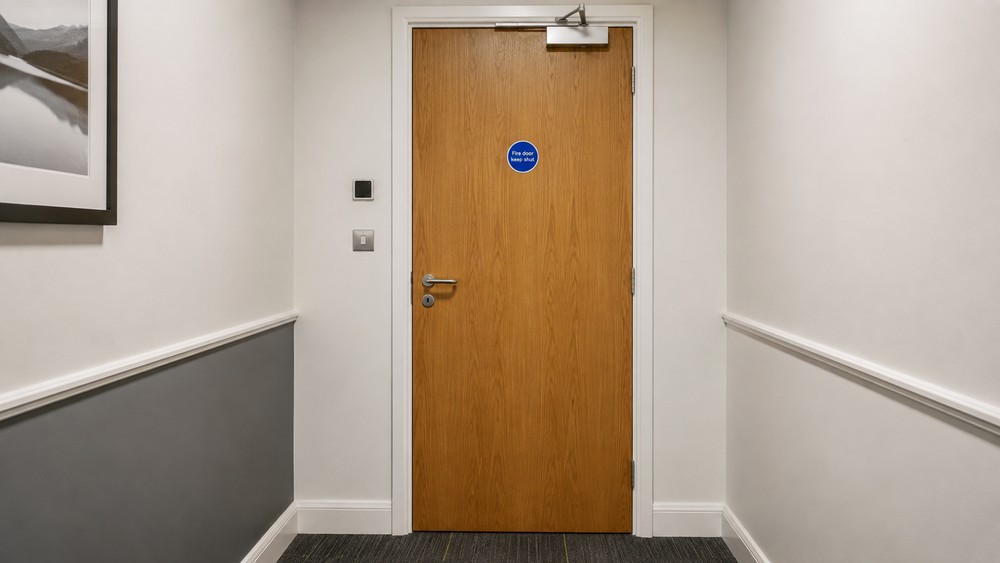
Summary: Understanding Fire Door Compliance and Regulations
Commercial property owners must schedule routine fire door inspections to guarantee life safety and legal compliance. You are legally required to verify that fire doors operate correctly, maintaining compartmentalisation during an emergency. Neglecting this critical maintenance regimen compromises building integrity and breaches strict fire door regulations in the UK.
- BS 8214 sets out the code of practice for the specification and maintenance of timber fire doors.
- The Fire Safety (England) Regulations 2022 mandate quarterly communal door checks for high-risk residential buildings.
- Routine maintenance prevents the catastrophic failure of vital intumescent strips and cold smoke seals.
Book a fire door inspection today.
What Are the Legal Requirements for Fire Door Inspections?
UK law demands that fire doors are maintained in optimal working condition to preserve building compartmentalisation. Under the Regulatory Reform (Fire Safety) Order 2005, the Responsible Person must ensure regular, documented inspections by a competent professional to avoid prosecution and protect occupants.
The foundation of all commercial fire safety relies on effectively stopping the spread of smoke and flames. Fire doors are not standard architectural features; they are highly engineered life-safety devices built to exact tolerances. When a fire breaks out, these passive fire protection assets must hold back extreme heat for a specified duration, typically 30, 60, or 120 minutes.
Navigating the landscape of fire door regulations in the UK can be complex for facility managers and property developers. However, the law is completely unequivocal: the Responsible Person holds ultimate liability for the building's fire safety measures. You cannot simply install a fire door, walk away, and assume the building remains compliant indefinitely.
How Did the Fire Safety Act Change Responsibilities?
Recent legislative changes have drastically increased the regulatory scrutiny placed on commercial and multi-occupancy buildings. The introduction of modern safety legislation has transformed how building data is managed, demanding absolute transparency throughout a structure's lifecycle.
Facility managers must now establish and maintain a transparent record of information regarding their passive fire protection. Every inspection, repair, and minor adjustment made to a fire door must be meticulously documented and easily accessible to auditing authorities. Ignorance of a door's condition is no longer a valid legal defence in the event of a catastrophic structural failure.
Government statistics reveal that UK fire and rescue services attended 39,859 building fires in the year ending March 2026 (Gov.uk Fire Statistics). This staggering figure underscores exactly why proactive compliance and rigorous inspection schedules are non-negotiable for property owners.
Who is Legally Responsible for Fire Door Safety?
The Regulatory Reform (Fire Safety) Order 2005 legally designates the building owner, employer, or facility manager as the Responsible Person. This individual holds total liability for ensuring that fire doors are systematically inspected, adequately maintained, and fully compliant with current safety standardisations.
This legal duty cannot be entirely delegated away to third-party contractors or ignored due to budget constraints. The Responsible Person must proactively ensure that all fire safety measures, including escape routes and passive fire containment systems, remain fit for purpose at all times. If a fire door fails during an emergency, investigators will scrutinise the maintenance records managed by this designated individual.
To ensure total compliance, these doors must be continuously integrated into your broader safety strategy. This is why thorough fire risk assessments are the essential first step in identifying which doors require immediate remediation, adjustment, or full replacement.
Why is the Golden Thread Critical for Compliance?
The concept of the "golden thread" dictates that accurate, up-to-date safety information must be passed seamlessly between building owners, facility managers, and regulatory bodies. This transparent flow of data ensures that a building's original safety design is never compromised by poor maintenance or unrecorded alterations.
When facility managers utilise digital logging systems for their fire door inspections, they create an irrefutable audit trail. This digital trail proves to local fire authorities that the building is being actively managed in accordance with the latest legislative frameworks. Without this verifiable data, proving compliance during a post-incident investigation is virtually impossible.
Data from the Fire Door Inspection Scheme (FDIS) reveals that a staggering 75% of inspected fire doors fail to meet required safety standards (FDIS Survey). This high failure rate demonstrates why relying on generic visual checks is dangerously inadequate for protecting life and property.
How Frequently Must Commercial Fire Doors Be Inspected?
Commercial fire doors should be formally inspected at least every six months by a qualified professional. Buildings with high traffic, such as hospitals or schools, require more frequent quarterly inspections to identify wear and tear before it compromises the fire-resisting assembly.
The exact frequency of your inspection programme depends heavily on the operational environment of your commercial premises. A fire door situated in a highly trafficked warehouse corridor will naturally degrade much faster than a fire door leading to a rarely accessed basement plant room.
Regular visual checks should also be conducted weekly by on-site maintenance staff. These quick, documented assessments ensure that self-closing devices have not been violently tampered with and that the doors are not being illegally wedged open for convenience.
What is the Impact of the Fire Safety (England) Regulations 2022?
For multi-occupied residential buildings over 11 metres in height, the law is highly prescriptive. The Fire Safety (England) Regulations 2022 legally compel Responsible Persons to undertake quarterly checks on all communal fire doors to guarantee residential safety.
These updated regulations were carefully designed to eliminate any lingering ambiguity regarding building safety responsibilities. They place a strict, measurable duty on building owners to provide transparent safety information directly to residents and local enforcement authorities. Engaging professional fire door inspection services removes the guesswork, providing you with a fully auditable trail of compliance.
Furthermore, fire and rescue services attended 695 fires in purpose-built high-rise flats in the year ending March 2026 (Gov.uk Fire Statistics). In these complex structures, a single failed fire door can immediately threaten hundreds of lives and trigger rapid vertical fire spread.
What Are the Most Common Reasons for Fire Door Failures?
Fire doors typically fail inspections due to excessive gap clearances, damaged intumescent seals, or faulty closing mechanisms. Even minor hardware alterations or general daily wear can entirely void the door's official fire rating and structural integrity.
A fire door operates as a complete, rigorously tested assembly rather than a standalone component. It relies on the perfect interaction of the frame, the load-bearing hinges, the CE-marked locks, the fire-rated glazing, and the expanding seals. If a single component fails to meet the required standardisation, the entire door assembly fails the audit.
During fire risk assessment surveys, inspectors frequently discover doors that have been severely compromised by poorly executed maintenance. Installing incorrect, non-compatible hardware or carelessly painting over delicate smoke seals are common errors that instantly invalidate the door's safety certification.
Why Are Intumescent Strips and Cold Smoke Seals Critical?
Toxic smoke inhalation remains the leading cause of fatalities during commercial building fires. Cold smoke seals are strategically designed to physically block lethal fumes from passing through the minute gaps around a door during the early, smouldering phases of an emergency.
As the ambient temperature in the corridor rapidly rises, the intumescent strips take over the primary defensive role. These chemically engineered strips expand to many times their original size when exposed to extreme heat, completely sealing the perimeter gap and preventing flames from breaching the safe compartment.
If the gap between the door leaf and the frame exceeds the maximum 3mm tolerance allowed by BS 8214, the intumescent seal may fail to bridge the void. This rapid spread immediately defeats any other mitigation strategies you have established, putting both lives and your commercial assets in profound jeopardy.
What Are the Commercial Benefits of a Strict Maintenance Regimen?
Maintaining fire doors protects your commercial assets by confining fire damage to a single, controllable compartment. Beyond legal compliance, a strict maintenance regimen ensures business continuity, prevents catastrophic inventory loss, and significantly reduces your corporate insurance premiums.
When executives think about fire protection investments, they often focus solely on active suppression systems, such as commercial sprinklers governed by BS EN 12845 or alarms dictated by BS 5839-1. However, passive systems are equally vital for ultimate asset protection, forming the resilient physical barriers that allow active suppression systems the crucial time they need to operate effectively.
Adhering strictly to fire door regulations demonstrates a highly robust commitment to corporate risk management. Insurance providers look favourably upon organisations that can present a flawless, continuous record of accredited maintenance.
How Does Asset Protection Reduce Insurance Premiums?
Commercial insurance underwriters calculate your premiums based on the calculated risk of a total asset loss occurring on your site. By maintaining impeccable fire compartmentalisation, you restrict potential fire damage to a highly localised area, thereby minimising the massive financial liability for the insurer.
A minor, contained fire in a single server room should never result in the devastating loss of an entire commercial complex. If your fire doors function precisely as designed, your business can recover and resume operations rapidly, saving your organisation millions in lost revenue and extended downtime.
Conversely, if a post-fire investigation reveals that negligent maintenance allowed a fire to spread unchecked, your insurance policy may be completely invalidated. Investing in an accredited, regular maintenance programme is merely a fraction of the cost of a denied insurance claim.
How Can Firecom Systems Ensure Total Compliance?
Firecom Systems delivers end-to-end fire safety compliance by integrating bespoke design, expert installation, and rigorous ongoing maintenance. Our turnkey solutions guarantee that every fire door on your premises meets the exact specifications of current British Standards.
Navigating the deep intricacies of passive fire protection requires high-level technical expertise and an uncompromising approach to quality control. We do not offer generic advice; we deliver highly engineered solutions that align perfectly with your building's specific structural risk profile.
"Compliance is never a one-off event: it is a continuous commitment to life safety," states Stuart Rye, Managing Director of Firecom Safety Systems. "When building owners treat fire door maintenance as a simple box-ticking exercise, they compromise the entire suppression and compartmentalisation strategy of their premises."
What is the Value of an End-to-End Fire Protection Partner?
Relying on multiple disparate contractors for different aspects of your fire strategy often leads to critical communication gaps and fundamentally incompatible systems. An end-to-end partner takes unified, uncompromising responsibility for your entire safety infrastructure, ensuring seamless integration between your active alarms and your passive physical containment.
We deeply understand the intense commercial pressures faced by property developers and facility managers today. That is exactly why our turnkey approach is intelligently designed to minimise disruption to your daily operations while simultaneously maximising your overall compliance posture.
By choosing Firecom Systems, you are intentionally investing in a proven, accreditation-led methodology. This proactive approach safeguards your people, protects your property, and fortifies your legal standing against rigorous enforcement audits.
Ensure your premises are fully compliant and protected. To discuss your fire protection requirements:
- Call our experts on 0115 822 2000
For multi-occupied residential buildings over 11 metres in height, the law is highly prescriptive. The Fire Safety (England) Regulations 2022 legally compel Responsible Persons to undertake quarterly checks on all communal fire doors to guarantee residential safety.
These updated regulations were carefully designed to eliminate any lingering ambiguity regarding building safety responsibilities. They place a strict, measurable duty on building owners to provide transparent safety information directly to residents and local enforcement authorities. Engaging professional fire door inspection services removes the guesswork, providing you with a fully auditable trail of compliance.
Furthermore, fire and rescue services attended 695 fires in purpose-built high-rise flats in the year ending March 2026 (Gov.uk Fire Statistics). In these complex structures, a single failed fire door can immediately threaten hundreds of lives and trigger rapid vertical fire spread.