Fire sprinkler systems are a non-negotiable component of modern fire safety, providing the most effective means of suppressing a fire in its early stages. They are proven to save lives, protect property, and ensure business continuity. Our guide provides a comprehensive overview of fire sprinkler systems in the UK, detailing the different system types, the variety of sprinkler heads, and the critical importance of a professional fire sprinkler system installation.
We will explore the operational realities, debunk common myths, and delve into the specific requirements for a commercial fire sprinkler system (governed by BS EN 12845) and residential systems (BS 9251:2021). Understanding and adhering to these standards is not optional but a legal requirement under The Regulatory Reform (Fire Safety) Order 2005. Our guide outlines the path to full compliance, from initial design and water supply considerations to ongoing maintenance and testing, ensuring your fire protection sprinkler system is ready to activate when needed.
Introduction: The First Line of Defence
In the event of a fire, time is the single most critical factor. An effective, active fire protection sprinkler system can be the difference between a minor incident and a catastrophic loss. As one of the UK’s most trusted fire safety specialists, Firecom Safety Systems has seen firsthand the protective power of a correctly specified and installed system.
Contrary to the dramatic scenes in Hollywood films, a fire does not simultaneously trigger every sprinkler head in a building. The reality is far more intelligent and efficient: only the sprinkler head, or heads, in the immediate vicinity of the fire's high heat are activated. This targeted suppression controls or even extinguishes the blaze long before the fire and rescue service arrives, minimising water damage and, most importantly, protecting lives.
Our guide will provide essential information for building owners and responsible persons on fire sprinkler systems, covering the main types, the benefits of a professional fire sprinkler system installation, and the legal framework governing commercial fire sprinkler system compliance.
How Do Fire Sprinkler Systems Work?
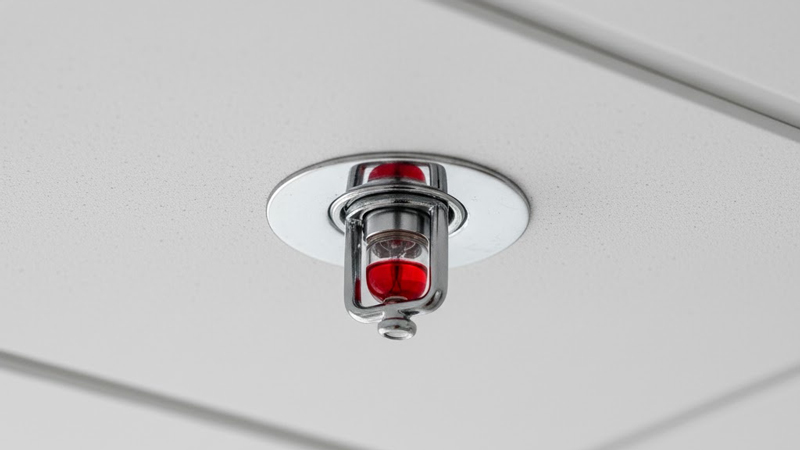
At its core, a fire sprinkler system is a network of pipework, typically installed at ceiling level, charged with water under pressure. Each sprinkler head contains a heat-sensitive element, either a glass bulb or a fusible link, designed to activate at a specific temperature:
- Detection: A fire starts, and the hot gases rise to the ceiling.
- Activation: When the temperature at a specific sprinkler head reaches its activation point (e.g., 68°C), the heat-sensitive element breaks.
- Suppression: This breakage releases a plug, allowing the pressurised water to spray outwards through a deflector plate. This deflector is designed to distribute the water over a specific area, suppressing the flames and cooling the surrounding area to prevent the fire from spreading.
Only the heads exposed to this high heat will operate, ensuring water is applied precisely where needed.
The Key Benefits of Installing Fire Sprinklers
The case for installing fire sprinkler systems is built on a foundation of safety and risk reduction. The benefits are clear and significant:
- Life Safety: This is the primary benefit. Sprinklers control a fire, preventing the build-up of toxic smoke and heat, which gives occupants more time to escape safely. Statistics overwhelmingly show that the risk of death in a fire is drastically reduced in buildings with sprinklers.
- Property Protection: By activating in the fire's incipient stage, sprinklers limit the spread of flames. This massively reduces fire, smoke, and water damage compared to an uncontrolled fire that requires extensive intervention from the fire brigade.
- Business Continuity: A fire can be financially devastating for a commercial enterprise. A sprinkler system minimises damage and disruption, allowing the business to resume operations more quickly.
- Reduced Insurance Premiums: Insurers recognise sprinklers' proven risk reduction. Properly installed and maintained systems can often lead to significant reductions in insurance premiums.
Environmental Impact: A sprinkler system typically uses a fraction of the water the fire and rescue service would deploy to extinguish the same blaze.
Types of Fire Sprinkler Systems
The system choice depends on the building's environment, occupancy, and risk profile.
Wet Pipe Systems
This is the most common, reliable, and cost-effective type of sprinkler system. The pipework is permanently charged with water, allowing immediate water discharge when a sprinkler head activates. They are suitable for most standard commercial and residential buildings with no risk of the temperature dropping below freezing.
Dry Pipe Systems
These systems are designed for unheated spaces where water in the pipes could freeze, such as loading bays, cold stores, or unheated warehouses. The pipes are filled with compressed air or nitrogen. When a sprinkler head activates, the air pressure drops, which opens a 'dry pipe valve' located in a heated area. This allows water to flow into the pipework and out of the activated head. There is a short delay in water delivery as the air is purged.
Pre-Action Systems
Used in high-value environments where accidental water discharge would be catastrophic (e.g., museums, data centres, or archives). These systems require a two-step activation. A detection system (like smoke or heat detectors) must first activate. This opens the pre-action valve, allowing water to fill the pipes. Only then, if a sprinkler head activates from the fire's heat, will water be discharged.
Subsidiary Alternate Systems
These specialist systems are designed to be charged with either air (in winter) or water (in summer), providing flexibility for properties with fluctuating environmental conditions.
Understanding Fire Sprinkler Head Types
The sprinkler head itself is a precision-engineered component. Different designs exist to suit various applications and discharge patterns.
- Fusible Link: Uses a metal element that melts at a set temperature, opening the sprinkler head.
- Glass Bulb: Contains a liquid-filled glass bulb that bursts at a specific temperature, releasing the water.
- Pendent: The most common type, installed to hang down from the pipework. Water is discharged downwards in a conical pattern.
- Upright: Designed to stand upright on top of the pipework, often used in plant rooms or spaces with high, exposed ceilings. Water is discharged upwards against a deflector.
- Sidewall Pattern: Installed on or in a wall, designed to discharge water outward in a paraboloid (half-parabola) pattern. Ideal for corridors or small rooms.
- Recessed: The head is partially concealed within the ceiling, with the heat-sensing element positioned just above the lower plane of the ceiling.
- Quick Response: Features a more sensitive temperature-sensing element, designed to react faster. These are standard for life-safety systems, such as in residential and domestic properties.
Residential Pattern: Specifically designed for residential use, this head discharges water outwards and downwards to cover the walls and floor, enhancing occupant survivability.
The Professional Fire Sprinkler System Installation Process
A fire sprinkler system installation is a complex engineering project that qualified professionals must undertake to ensure it functions correctly and complies with British Standards.
- Consultation and Design: The process begins with a full site survey and risk assessment. Our engineers will determine the building's hazard class, design the optimal system, and identify the required water supply.
- Water Supply Determination: A reliable water supply is essential. This may be sourced directly from the town's main, provided it can meet the required pressure and flow. A dedicated water storage tank and pump arrangement will be required for larger systems or where the main is insufficient.
Note on Tanks: Sprinkler tanks are critical assets. They must be inspected regularly to ensure their integrity, checking for leaks, failing joints, or corrosion that could compromise the entire system.
- Installation: Certified engineers will install the network of pipework, control valves, and sprinkler heads per the approved design.
- Commissioning and Testing: Once installed, the system is filled, pressurised, and rigorously tested. This includes flow tests, pressure tests, and testing the alarm connections to ensure the system is fully operational.
Handover and Certification: The client has full documentation, operating instructions, and the necessary compliance certification.
Your Legal Duty: Fire Sprinkler System Compliance
Installing a system is only the first step. Ensuring ongoing fire sprinkler system compliance is a legal obligation for the 'Responsible Person' of any premises.
The Regulatory Reform (Fire Safety) Order 2005 (RRO)
The RRO is the cornerstone of fire safety law in England and Wales. It mandates that the Responsible Person must:
- Conduct a suitable and sufficient fire risk assessment.
- Implement appropriate fire safety measures to mitigate identified risks.
- Ensure all fire safety equipment, including sprinkler systems, is maintained in an efficient state, in efficient working order, and in good repair.
Failure to comply with the RRO can lead to severe penalties, including unlimited fines and imprisonment in the most serious cases.
BS EN 12845: Standard for Commercial Fire Sprinkler Systems
This is the British Standard governing commercial fire sprinkler system application design, installation, and maintenance. It is the benchmark for offices, warehouses, shopping centres, and industrial buildings. It specifies comprehensive requirements for:
- System design and hazard classification.
- Water supply standards, including pump and tank requirements.
- A stringent testing and maintenance schedule.
BS 9251:2021: Standard for Residential & Domestic Systems
This standard applies to fire sprinklers in homes, flats, care homes, and Houses in Multiple Occupation (HMOs). It was updated in 2021 to reflect higher safety standards, particularly in high-rise buildings.
- Risk Categories: BS 9251 defines risk categories (1, 2, and 3) based on building size, height, and occupant vulnerability (e.g., care homes).
11-Metre Rule: A significant change is the requirement for automatic fire sprinklers to be installed in all new blocks of flats with a top storey more than 11 metres above ground level.
Fire Sprinkler System Inspection & Testing: A Non-Negotiable Task
A sprinkler system is a life-safety device that must be serviced correctly and regularly. A "fit and forget" attitude is dangerous and non-compliant.
Why Regular Inspections Are Essential
Regular inspections by competent professionals are the only way to ensure your system will function correctly in an emergency. Over time, components can seize, corrosion can occur, or obstructions can impede sprinkler heads.
At Firecom Safety Systems, our industry-accredited engineers provide peace of mind. Our inspection services include:
- Quarterly Flow Switch Testing: Verifying that water flow correctly activates the fire alarm system.
- Annual Full-System Checks: A comprehensive service covering water supplies, pressures, valves, and all operational components.
- Fire Sprinkler Head Inspections: Visually checking heads for blockages, corrosion, paint, or physical damage.
- Pump and Tank Servicing: Maintaining your dedicated water supply's integrity and operational readiness.
Following each service (subject to any remedial works), we provide a full report and compliance certificate, demonstrating your system meets BS EN 12845 or BS 9251:2021 standards.
The Consequences of Non-Compliance
Ignoring your maintenance duties can have severe repercussions:
- Legal Action: A breach of the RRO can lead to enforcement action, prohibition notices, and prosecution.
- Invalidated Insurance: In the event of a fire, many insurers will request maintenance records. Your claim may be reduced or voided entirely if you cannot provide them.
Increased Fire Risk: The system may fail to operate correctly, leading to an uncontrolled fire and catastrophic loss of life or property.
Why Choose Firecom for Your Fire Protection Sprinkler System?
Navigating the complexities of fire sprinkler design, installation, and compliance requires a specialist partner. At Firecom Safety Systems, we provide a comprehensive, expert-led service across Nottingham, Derby, Leicester, and the wider UK.
- Industry Experts: Our team possesses over 20 years of experience in fire safety compliance.
- Certified Engineers: All our engineers are fully trained and accredited to the highest industry standards, including BS EN 12845 and BS 9251:2021.
- Comprehensive Services: We manage your system's entire lifecycle, from initial design and installation to long-term testing and maintenance.
- Reliable & Cost-Effective: We offer transparent pricing and reliable service, ensuring your premises are fully protected and compliant.
Secure Your Premises Today
A fully compliant fire protection sprinkler system is an essential investment in the safety of people and property. From an initial fire sprinkler system installation in a new build to retrofitting a commercial fire sprinkler system or ensuring your existing fire sprinkler systems are compliant, our team is ready to help.
Don’t leave your fire safety to chance. Call us today at 0115 822 2000 or visit our contact us page to schedule a consultation or inspection.