How Many Fire Extinguishers Do I Need for UK Business?
Determining exactly how many commercial fire extinguishers your premises needs is the foundation of structural safety and legal compliance. As the East Midlands' leading fire safety experts, Firecom Systems delivers definitive guidance on workplace protection, ensuring your facility exceeds regulatory requirements.
Discover the baseline BS 5306 regulations for calculating extinguisher volumes based on your floor space.
Learn how tailored risk assessments dictate the specific chemical agents required for unique on-site hazards.
Understand the strict positioning and travel distance rules that guarantee rapid suppression during an emergency.
How many fire extinguishers are legally required in a UK workplace?
UK fire regulations mandate a minimum of two Class A fire extinguishers for every floor of a commercial building up to 400 square metres. Facility managers must calculate this baseline accurately, yet many businesses still face unlimited fines because they overlook one critical structural junction.
This vulnerable junction is the transitional zone between distinct operational areas, such as a carpeted office leading directly into a hazardous manufacturing floor. When calculating your initial volume, the baseline requirement under the Regulatory Reform (Fire Safety) Order 2005 focuses heavily on mitigating standard solid combustible risks. Providing two Class A extinguishers guarantees you achieve the mandatory 26A Fire Rating, ensuring you possess sufficient suppression capability for immediate incident response.
However, baseline numbers are merely the starting point for total asset protection. According to enforcement guidelines published by the UK Government, failing to adequately provide and maintain fire safety equipment is a criminal offence punishable by an unlimited fine.
Does the size of my commercial premises dictate extinguisher numbers?
Floor space dictates baseline commercial fire extinguisher requirements under BS 5306-8. Businesses must install two water-based extinguishers per 400 square metres to achieve a combined 26A fire rating, ensuring adequate coverage for standard combustible materials across the entire operational footprint.
When a single floor exceeds 400 square metres, the calculation scales proportionally to guarantee that suppression coverage remains consistent. This volumetric approach ensures that regardless of the building's total size, personnel have immediate access to initial firefighting equipment. It is crucial to remember that this baseline exclusively addresses Class A risks, such as wood, paper, and textiles, which are universally present in almost all commercial environments.
How does a fire risk assessment influence my equipment needs?
A professional fire risk assessment identifies unique operational hazards that alter baseline equipment requirements. Evaluators analyse specific site conditions to mandate additional specialised extinguishers, ensuring your workplace possesses the exact chemical agents required to neutralise specific electrical or chemical threats.
While the floor space gives you your Class A baseline, a comprehensive Fire Risk Assessments process is what dictates the introduction of other extinguisher types. For example, if your assessment identifies a server room or a commercial kitchen, you are legally required to provide specific suppression agents designed for those exact hazards. This tailored approach is what transitions a building from merely meeting a quota to achieving genuine, robust asset protection.
Which types of commercial fire extinguishers does my facility require?
Commercial fire extinguishers provide critical asset protection by targeting specific classes of combustible materials. Selecting the correct suppression medium dictates whether a small incident is contained or escalates, but many facility managers compromise site safety because they misunderstand one crucial chemical reaction.
The fatal error occurs when personnel mistakenly deploy water-based units on live electrical panels, a reaction that instantly conducts lethal voltage back to the operator and violently accelerates the fire. To prevent this, UK business fire extinguisher requirements demand a strategic mix of suppression agents. Understanding the specific 'Class' of fire each unit tackles is paramount; you must pair the chemical agent directly to the predominant hazards within that specific zone.
Firecom Systems frequently encounters sites where generic equipment has been purchased online without a professional survey, leaving highly specific risks entirely unprotected. Data shared by regional services, such as Humberside Fire and Rescue Service, highlights that 86% of businesses that suffer a significant fire never recover, underscoring the absolute necessity of correct equipment specification.
When should I deploy water and foam fire extinguishers?
Water and foam extinguishers tackle Class A fires involving solid combustible materials like wood, paper, and textiles. Foam units also suppress Class B flammable liquid fires by creating a cooling blanket that smothers the flames and prevents hazardous vapour reignition.
Water is the most common and cost-effective suppression medium for standard office environments, relying on its rapid cooling effect to extinguish solid fuel fires. Foam extinguishers offer enhanced versatility; the aqueous film-forming foam (AFFF) rapidly seals the surface of burning liquids, effectively suffocating the fire by completely cutting off the oxygen supply.
Why are CO2 and dry powder extinguishers essential for specific risks?
CO2 and dry powder extinguishers neutralise electrical and flammable liquid fires effectively. Carbon dioxide safely displaces oxygen without leaving damaging residue on sensitive server equipment, while dry powder provides versatile, rapid suppression across Class A, B, and C hazard environments.
Carbon dioxide (CO2) is the mandatory choice for modern offices and data centres, as the non-conductive gas causes zero secondary damage to expensive electronic assets during deployment. Dry powder units, often referred to as 'multi-purpose' extinguishers, are highly effective but are generally restricted to outdoor or industrial use due to the significant risk of inhalation and visual impairment when discharged in confined indoor spaces.
Where must I position fire extinguishers for BS5306 compliance?
British Standard BS 5306-8 dictates precise location protocols for positioning commercial fire extinguishers safely. Equipment must remain highly visible, accessible, and correctly supported along primary escape routes, though numerous installations fail compliance audits because they ignore one vital spatial measurement.
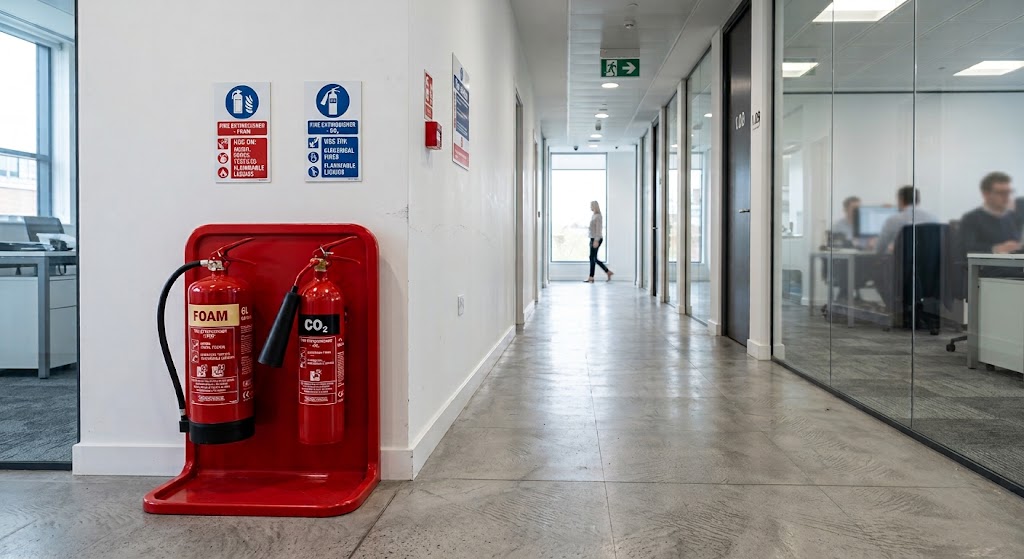
This frequently failed metric is the strict limitation on travel distances between a potential hazard and the nearest suppression point. Proper workplace fire safety demands that extinguishers are not merely scattered randomly; they must be strategically grouped into highly visible 'fire points'. These points are typically located adjacent to final exit doors, within stairwells, and positioned along designated primary escape routes to ensure they are accessible as personnel evacuate.
Expert Analysis & Industry Commentary: "The integrity of your fire safety strategy relies not just on the volume of extinguishers, but their immediate accessibility under stress. Adhering strictly to BS 5306-8 positioning protocols ensures that in the critical first sixty seconds of ignition, personnel are never forced to re-enter a hazard zone to retrieve suppression equipment." -Stuart Rye, Managing Director at Firecom Systems Ltd.
What are the correct mounting heights for fire safety equipment?
Fire safety regulations require engineers to mount extinguishers securely on walls or bespoke stands. Extinguishers weighing up to 4kg must be positioned with carrying handles 1.5 metres from the floor, whereas heavier units require a lower mounting height of 1 metre.
These specific height regulations, outlined by the British Standards Institution, are designed to guarantee that the equipment can be quickly and safely dismounted by individuals of varying physical strengths. If wall mounting is structurally impossible, perhaps due to glass partitioning or weak stud walls, businesses must utilise approved, robust fire stands to keep the units elevated and protected from daily floor-level damage.
How do travel distances affect fire extinguisher placement?
Travel distances dictate the maximum allowable gap between potential fire hazards and suppression equipment. Personnel should never travel more than 30 metres to reach a Class A extinguisher, ensuring rapid response capabilities before a minor ignition event compromises structural integrity.
For higher-risk areas, the travel distance rules become even more stringent. To reach a Class B (flammable liquid) or electrical fire extinguisher, the maximum permitted travel distance is reduced to just 10 metres. This ensures that highly volatile fires, which escalate much faster than standard combustible fires, can be tackled almost instantaneously.
How often must workplace fire extinguishers be serviced and maintained?
The Regulatory Reform (Fire Safety) Order 2005 compels building owners to enforce a rigorous maintenance regimen for all safety equipment. Qualified technicians execute mandated inspections to guarantee operational readiness, yet some businesses risk complete suppression failure because they bypass one fundamental mechanical inspection.
The critical failure point occurs when businesses neglect the internal discharge and pressure testing cycle, assuming a visual external check is sufficient for long-term viability. A robust maintenance regimen is not optional; it is a strict legal requirement. At Firecom Systems, our engineers are entirely focused on BS 5306 compliance and workmanship, rather than sales commissions, ensuring that when an extinguisher is passed as operational, it is genuinely ready to perform.
If you are unsure how many fire extinguishers do I need, or if your current provision is compliant, a professional site survey is the only definitive way to establish your legal standing and secure true peace of mind.
What does the annual basic service regimen involve?
An annual basic service involves a comprehensive mechanical inspection executed by a competent technician. Engineers verify correct pressure levels, examine the physical cylinder for corrosion, check tamper seals, and ensure the deployment mechanism remains flawless to guarantee immediate emergency activation.
During this annual audit, the engineer will also verify that the extinguisher remains in the correct location, is still appropriate for the surrounding risks, and that all supporting signage is fully visible. Any unit found to have lost pressure or suffered physical damage will be immediately flagged for repair or replacement to maintain site compliance.
When is an extended service or complete replacement necessary?
Extended maintenance regimens require technicians to discharge, internally inspect, and refill water, foam, and powder units every five years. Carbon dioxide extinguishers demand a rigorous ten-year hydraulic pressure test to verify cylinder integrity against extreme internal gas pressures.
These extended services are vital for ensuring the internal lining of the cylinder has not degraded and that the suppression agent itself remains chemically effective. Ultimately, most standard fire extinguishers have a maximum operational lifespan of around 15 to 20 years, after which they must be safely decommissioned and completely replaced with modern, CE-marked equipment.
Ensure your premises are fully compliant and protected. To discuss your fire protection requirements:
Unit 7B Wilford & South Industrial Estate Ruddington Lane Nottingham NG11 7EP
Website made with ♡ by Lnet Digital
We use cookies to personalise content and ads, to provide social media features and to analyse our traffic. We also share information about your use of our site with our social media, advertising and analytics partners, who may combine it with other information that you have provided to them or that they have collected from your use of their services. You consent to our cookies if you continue to use our website.
We use cookies to personalise content and ads, to provide social media features and to analyse our traffic. We also share information about your use of our site with our social media, advertising and analytics partners, who may combine it with other information that you have provided to them or that they have collected from your use of their services. You consent to our cookies if you continue to use our website.
Necessary cookies help make a website usable by enabling basic functions like page navigation and access to secure areas of the website. The website cannot function properly without these cookies.
Preference cookies enable a website to remember information that changes the way the website behaves or looks, like your preferred language or the region that you are in.
Statistic cookies help website owners to understand how visitors interact with websites by collecting and reporting information anonymously.
Marketing cookies are used to track visitors across websites. The intention is to display ads that are relevant and engaging for the individual user and thereby more valuable for publishers and third-party advertisers.
Unclassified cookies are cookies that we are in the process of classifying, together with the providers of individual cookies.